1
/
of
10
Wilier Triestina
Wilier Verticale SLR frameset
Wilier Verticale SLR frameset
Regular price
$7,000.00 USD
Regular price
Sale price
$7,000.00 USD
Shipping calculated at checkout.
Quantity
Couldn't load pickup availability
Our lightest bike ever
Lightness must be controlled. Making a lightweight frame is relatively simple, but making a lightweight one with top-notch performance and riding qualities requires a strong legacy.
The Verticale SLR is the best example of what we have been, and of what we do best: a racing bike that has improved weight over the Wilier 0 SLR - the previous climbing model made by Wilier - by almost 10% (9.73% on the kit comprising frame, fork, handlebars, and seatpost).
1623 g for the Verticale SLR, 1798 g for the 0 SLR.
Lighter weight, greater responsiveness, improved performance levels.
The Verticale SLR is today the best calling card for Wilier, the new generation of the best Italian bicycle manufacturers.
The Verticale SLR is the best example of what we have been, and of what we do best: a racing bike that has improved weight over the Wilier 0 SLR - the previous climbing model made by Wilier - by almost 10% (9.73% on the kit comprising frame, fork, handlebars, and seatpost).
1623 g for the Verticale SLR, 1798 g for the 0 SLR.
Lighter weight, greater responsiveness, improved performance levels.
The Verticale SLR is today the best calling card for Wilier, the new generation of the best Italian bicycle manufacturers.
Outstanding carbon
When we address the frame of a climbing bike, the first aspect we need to consider is the raw material used. Using the highest quality composite materials is the starting point to give rise to a project that focuses fully on top-level performance.
For the Verticale SLR, we specifically used 3 types of fibres produced by Toray, a Japanese multinational and leader in the carbon fibre market, especially T800, T1100, and M46JB.
For the Verticale SLR, we specifically used 3 types of fibres produced by Toray, a Japanese multinational and leader in the carbon fibre market, especially T800, T1100, and M46JB.
New integrated V Bar
The handlebar is carbon monocoque and features a brand-new design, weighing approximately 310 grams.
Its standout feature is the special shape with differentiated handlebar width: when viewed from the front, the grip area at the controls is narrower than the lower section of the handlebar. The distinctive shape was designed to provide practical solutions for professional riders, who, from season to season, strive for optimal aerodynamic performance while staying within the limits set by UCI regulations.
There is a trend to narrow it while nevertheless having a wider low grip to guarantee better handling, which is a key requirement when sprinting. The delta between the top and the bottom is 30 mm.
V Bar, like the other monocoque handlebars in the Wilier range, is also compatible with our other premium bikes. It is available in 6 sizes, 2 with a width of 37/40mm, with 90 and 100mm stems, 4 with a width of 39/42mm, with 110, 120, 130 and 150mm stems.
Its standout feature is the special shape with differentiated handlebar width: when viewed from the front, the grip area at the controls is narrower than the lower section of the handlebar. The distinctive shape was designed to provide practical solutions for professional riders, who, from season to season, strive for optimal aerodynamic performance while staying within the limits set by UCI regulations.
There is a trend to narrow it while nevertheless having a wider low grip to guarantee better handling, which is a key requirement when sprinting. The delta between the top and the bottom is 30 mm.
V Bar, like the other monocoque handlebars in the Wilier range, is also compatible with our other premium bikes. It is available in 6 sizes, 2 with a width of 37/40mm, with 90 and 100mm stems, 4 with a width of 39/42mm, with 110, 120, 130 and 150mm stems.
Brake sheath routing
We also worked on the high part of the grip, particularly as regards the routing of the brake sheaths.
The contact surface has been increased to improve the passage of the sheath inside the handlebar.
The contact surface has been increased to improve the passage of the sheath inside the handlebar.
ntegrated cyclocomputer mount
The pursuit of a reduced overall handlebar weight has led us to develop a purpose-designed cyclocomputer mount stick, made entirely of aluminium which, unlike its predecessors, fits entirely in the handlebar.
It is secured thanks to two through holes which have enabled us to optimise weight further compared to previous models.
At the rear, in the fork-sleeve handlebar stem area, you can see that the tightening system is different . The screws tighten on two aluminium inserts, a solution that makes replacement easier in the tightening part, while also improving the distribution of force on the composite part.
The rear of the stem is finished with a rubber insert to prevent dirt and sweat from penetrating the handlebar, thereby preserving its reliability in the long run.
It is secured thanks to two through holes which have enabled us to optimise weight further compared to previous models.
At the rear, in the fork-sleeve handlebar stem area, you can see that the tightening system is different . The screws tighten on two aluminium inserts, a solution that makes replacement easier in the tightening part, while also improving the distribution of force on the composite part.
The rear of the stem is finished with a rubber insert to prevent dirt and sweat from penetrating the handlebar, thereby preserving its reliability in the long run.
Aerodynamic performance
Although aerodynamic efficiency was not the primary objective when developing the Verticale SLR (a goal already excellently achieved by Filante SLR for the aero segment), we have noted that the CDA (Drag Area Coefficient) has improved with the Verticale SLR, effectively making it more aerodynamic than the Wilier 0 SLR.
The CDA falls by almost 2% at 50 km/h speeds and up to 4% at higher speeds, such as 70 km/h. To convert this data into more understandable terms, this translates to a time saving of 2 seconds per kilometre at 50 km/h and of 3 seconds at 70 km/h.
However, we know that the data collected in the wind tunnel from the bicycle alone does not reveal the full extent of this aerodynamic success. Only 10% of overall air resistance is due to the bike; 1% is due to the wheels and the rest - a vast majority - to the cyclist.
This is why we focused on new geometries and the innovative V Bar monocoque handlebar, solutions that allow the cyclist to adopt a more aerodynamic and efficient position. The reduction in CDA, keeping the cyclist and riding position constant, is 5.7% at 50 km/h and rises to 8.7% at 70 km/h.
The CDA falls by almost 2% at 50 km/h speeds and up to 4% at higher speeds, such as 70 km/h. To convert this data into more understandable terms, this translates to a time saving of 2 seconds per kilometre at 50 km/h and of 3 seconds at 70 km/h.
However, we know that the data collected in the wind tunnel from the bicycle alone does not reveal the full extent of this aerodynamic success. Only 10% of overall air resistance is due to the bike; 1% is due to the wheels and the rest - a vast majority - to the cyclist.
This is why we focused on new geometries and the innovative V Bar monocoque handlebar, solutions that allow the cyclist to adopt a more aerodynamic and efficient position. The reduction in CDA, keeping the cyclist and riding position constant, is 5.7% at 50 km/h and rises to 8.7% at 70 km/h.
Seatpost with light or integrated number
We redesigned the seatpost with two possible setbacks: 0° and -15°, both are equipped with two special holes for the installation of a rear light or to affix race numbers.
New seatpost clamp system
We fine-tuned the fastening device which no longer fastens from the top but diagonally from the bottom.
This tightening system has allowed us to lighten the weight at that point of the frame with respect to the 0 SLR.
This tightening system has allowed us to lighten the weight at that point of the frame with respect to the 0 SLR.
New derailleur coupling
Another major and fundamental new feature is the front derailleur coupling, which for the Verticale SLR is no longer riveted to the frame and has become repositionable.
This is how we succeeded in cutting down the weight of the coupling and having two possible configurations allowing the mounting in one case of a 50-34 or 53-39 compact crankset and in the other an oversized crankset with up to 55-56 teeth as required by our World Tour teams.
This is how we succeeded in cutting down the weight of the coupling and having two possible configurations allowing the mounting in one case of a 50-34 or 53-39 compact crankset and in the other an oversized crankset with up to 55-56 teeth as required by our World Tour teams.
David Gaudu, professional athlete from the Groupama - FDJ Team
"You can feel that the Verticale was designed to respond specifically when the gradients are challenging and you’re dancing on the pedals. It gives you back exactly what you give it and you feel in complete control during highly technical high-speed descents: this is very important because a professional cyclist needs to fully trust his bike.
It truly is an excellent bike for mountain stages. It will be my trusted companion throughout the Tour de France and I can’t wait to test it during the mountain stages."
Shaped dropout
As far as the rear triangle is concerned, we have a new rear dropout designed with a special outlined shape which prevents it from rotating thereby guaranteeing greater reliability.
The interchangeable part is cantilever, which allows considerable space between the chain and the stays and avoids possible points of contact between the chain itself and the stay.
Everything is compatible with wireless and semi-wireless groups.
The interchangeable part is cantilever, which allows considerable space between the chain and the stays and avoids possible points of contact between the chain itself and the stay.
Everything is compatible with wireless and semi-wireless groups.
Asymmetrycal fork
The challenge was to improve the weight and performance of an apparently simple component. We retained the characteristic asymmetrical shape.
The sections on the rod housing the brake calipers have been oversized, whereas the right seat stay sections are lighter and thinner.
A new feature is the left fork stay which is twisted. This shape is an improvement for two reasons: improved orientation of the carbon fibres during rolling (to respond better to stresses) and the improved resistance to forces exerted by the calipers during braking.
The sections on the rod housing the brake calipers have been oversized, whereas the right seat stay sections are lighter and thinner.
A new feature is the left fork stay which is twisted. This shape is an improvement for two reasons: improved orientation of the carbon fibres during rolling (to respond better to stresses) and the improved resistance to forces exerted by the calipers during braking.
Miche Light RD Thru Axles
These axles, made of anodized AL 7075-T6, embody the perfect blend of strength and lightness. Specifically engineered for Wilier Triestina's Verticale SLR, Filante SLR, and 0 SLR road models, they deliver exceptional reliability and optimal performance.
Weighing just 64 grams per pair, these axles provide both speed and ease of use, making them the ideal choice for those striving for the best in any situation.
Weighing just 64 grams per pair, these axles provide both speed and ease of use, making them the ideal choice for those striving for the best in any situation.
New racing geometries
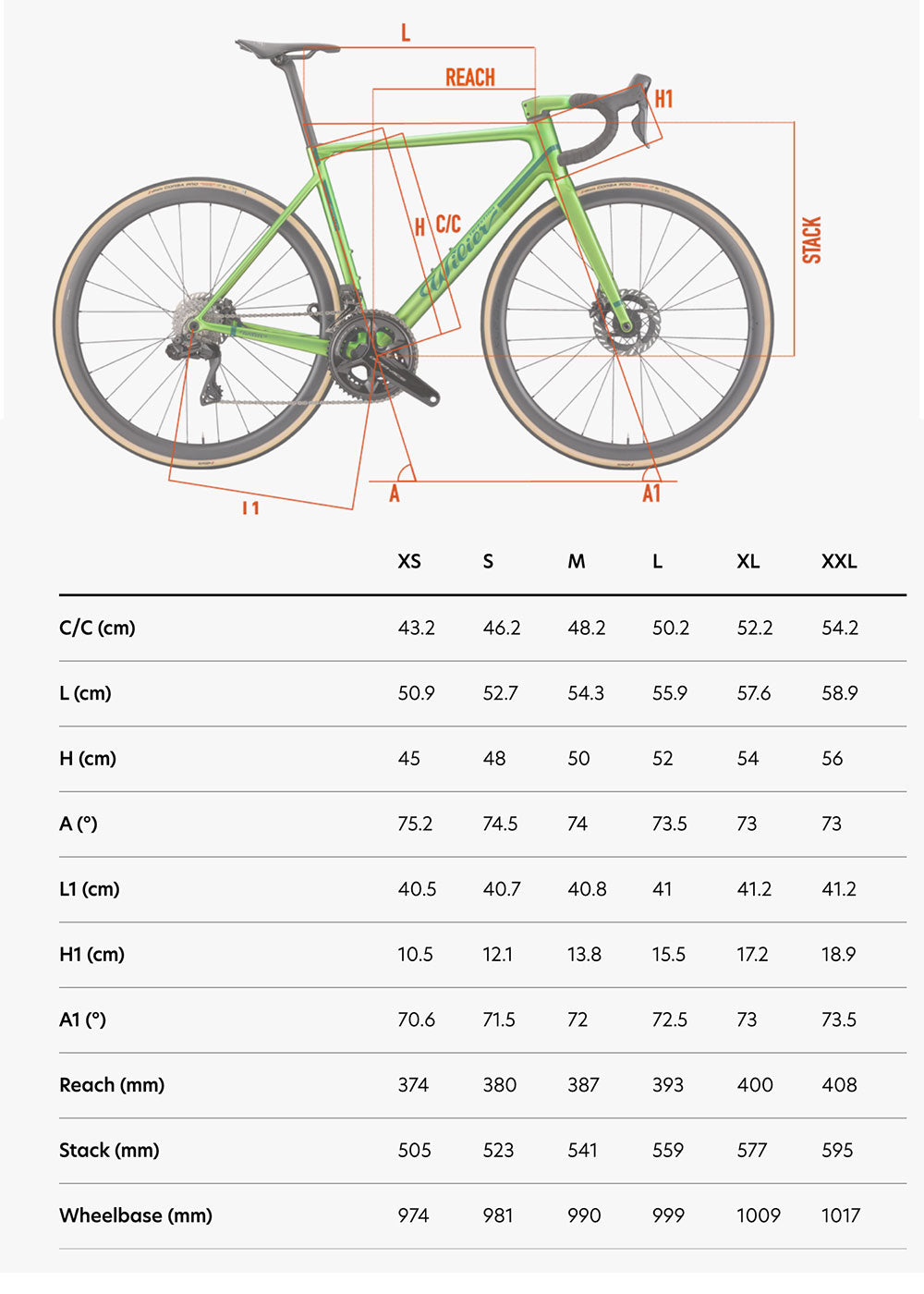
The first great difference compared to the Wilier 0 SLR was the change in reach. We focused on what the cyclist is most interested in. In other words their hand position in relation to the bottom bracket box.
The result is a change in the frame geometries and in the handlebar geometries. The bike stack has remained unchanged. Its reach on the other hand has been slightly shortened for sizes XS and S, while for sizes XL and XXL it has been extended compared to our classic geometries.
As for the handlebar, we focused on positions C0 and C1, the most performing for the athlete. This allowed us to deliver a product which, in terms of fitting, is suitable for all needs and any type of rider.
The result is a change in the frame geometries and in the handlebar geometries. The bike stack has remained unchanged. Its reach on the other hand has been slightly shortened for sizes XS and S, while for sizes XL and XXL it has been extended compared to our classic geometries.
As for the handlebar, we focused on positions C0 and C1, the most performing for the athlete. This allowed us to deliver a product which, in terms of fitting, is suitable for all needs and any type of rider.
Improve your riding position with accu-fit
Correct positioning in the saddle is one of the most essential issues for cyclists, especially for competitors and long-distance cyclists. While with steel bikes, it was relatively easy to measure the length of the tubes, as the years passed, and with the introduction of sloping top tubes, defining measurements has become increasingly complex. So, in addition to the classic values of height, length and angles, we now consider reach & stack data and horizontal and vertical distance values between the centre of the bottom bracket and the centre of the upper part of the head tube.
But modern bicycles have made measurement even more complex, since they are complete and complex systems based on the combination of the frame, handlebar spacers and monocoque handlebars. When buying a bike, it is essential to know the size of every bike element based on your body size and shape. As manufacturers of frames and monocoque handlebars, we have added a new value to the measurement of the frame which combines the length of the head tube and the dimensions of the monocoque handlebar.
This coordinate, called ACCU-FIT, determines the distance between the bottom bracket's center and the handlebar's center. It is clear that for every model there are as many coordinates as frame sizes multiplied by the number of handlebar sizes and the configuration of spacers.
For the Verticale SLR the biggest news is that we have succeeded in achieving an even filling range in space, even for the new position in C1. This research and development process was conducted in close partnership with the Groupama - FDJ Équipe Cycliste team.
But modern bicycles have made measurement even more complex, since they are complete and complex systems based on the combination of the frame, handlebar spacers and monocoque handlebars. When buying a bike, it is essential to know the size of every bike element based on your body size and shape. As manufacturers of frames and monocoque handlebars, we have added a new value to the measurement of the frame which combines the length of the head tube and the dimensions of the monocoque handlebar.
This coordinate, called ACCU-FIT, determines the distance between the bottom bracket's center and the handlebar's center. It is clear that for every model there are as many coordinates as frame sizes multiplied by the number of handlebar sizes and the configuration of spacers.
For the Verticale SLR the biggest news is that we have succeeded in achieving an even filling range in space, even for the new position in C1. This research and development process was conducted in close partnership with the Groupama - FDJ Équipe Cycliste team.
Specifications
Specifications
Share